REQ-uired Reading
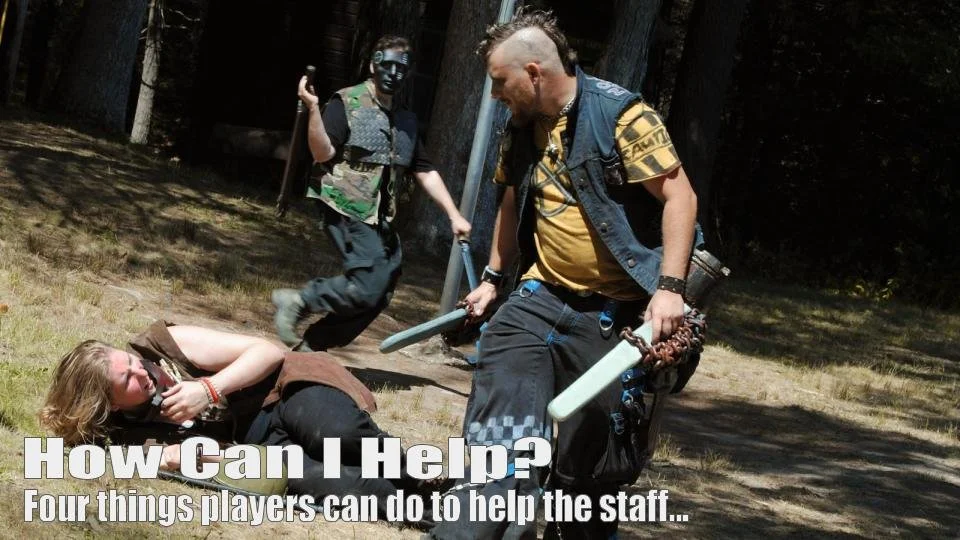
Four Things Players Can Do To Help the Staff
At Dystopia Rising New York, we have an amazing player base who’s always asking us “How can we help out?” Unfortunately, at events we’re often so busy we don’t have a good answer other than “Um, pick that thing up and put it down over there.” So between events, we came up with five things our players can do if they want to help out the staff.
At Dystopia Rising New York, we have an amazing player base who’s always asking us “How can we help out?” Unfortunately, at events we’re often so busy we don’t have a good answer other than “Um, pick that thing up and put it down over there.” So between events, we came up with four things our players can do if they want to help out the staff.
Phys Reps
We’ve had this come up multiple times and it’s actually caused a couple of larger issues: you have to phys rep any item not stored in your supply bag. Further, some items need phys reps - typically weapons and armor, and some of these require specific phys reps. In addition, you have to have a phys rep for any injectable or brew you use. If you don’t have a phys rep for an item, it can be “stored” in your supply bag, but you still have to take the item card out to use it. We’ve gotten lax on this, because honestly, it doesn’t ruin the staff’s game if you don’t use a phys rep… but when other players are watching and reacting to what you do… they need to know you did something.
Mess Up, Fess Up
Whenever we do card checks after a big fight, there’s a tremendous number of characters who happen to have used exactly all their Mind. In a way, this makes sense - you use Mind until you’re out - but we’re also pretty sure some people are losing count and afraid of getting “in trouble.” Please, if you make a mistake, it’s a mistake… you’re not a bad person or a cheater. Let us know, and we’ll make a note and try to help you out (perhaps with coaching, if you want it, on how to keep track of skills during combat). If you tell us “Hey, I messed up” we’re not going to give you a warning, unless it’s particularly egregious (i.e. “Hey, I messed up and accidentally spent 12 Resolve in that fight).
Light Discipline
We emphasize the use of red flashlights and everyone is pretty good about using them… but every now and then we have a problem. Red light doesn’t interfere with night vision, but having a light shined in your eyes still interferes with your ability to focus on anything other than that light. Please, carry a flashlight, use a flashlight, but never shine a flashlight at another person's face. (We don’t know if our guides get flashlights shined at them more often than other people… maybe it’s to see the green headband… but it happens a lot).
Read This Chart
We have five calls that confuse players more than any others… so we made a chart. Remember, if something is delivered via a strike, you can call Avoid, so the counters on the chart below are in addition to Avoiding a physical strike.
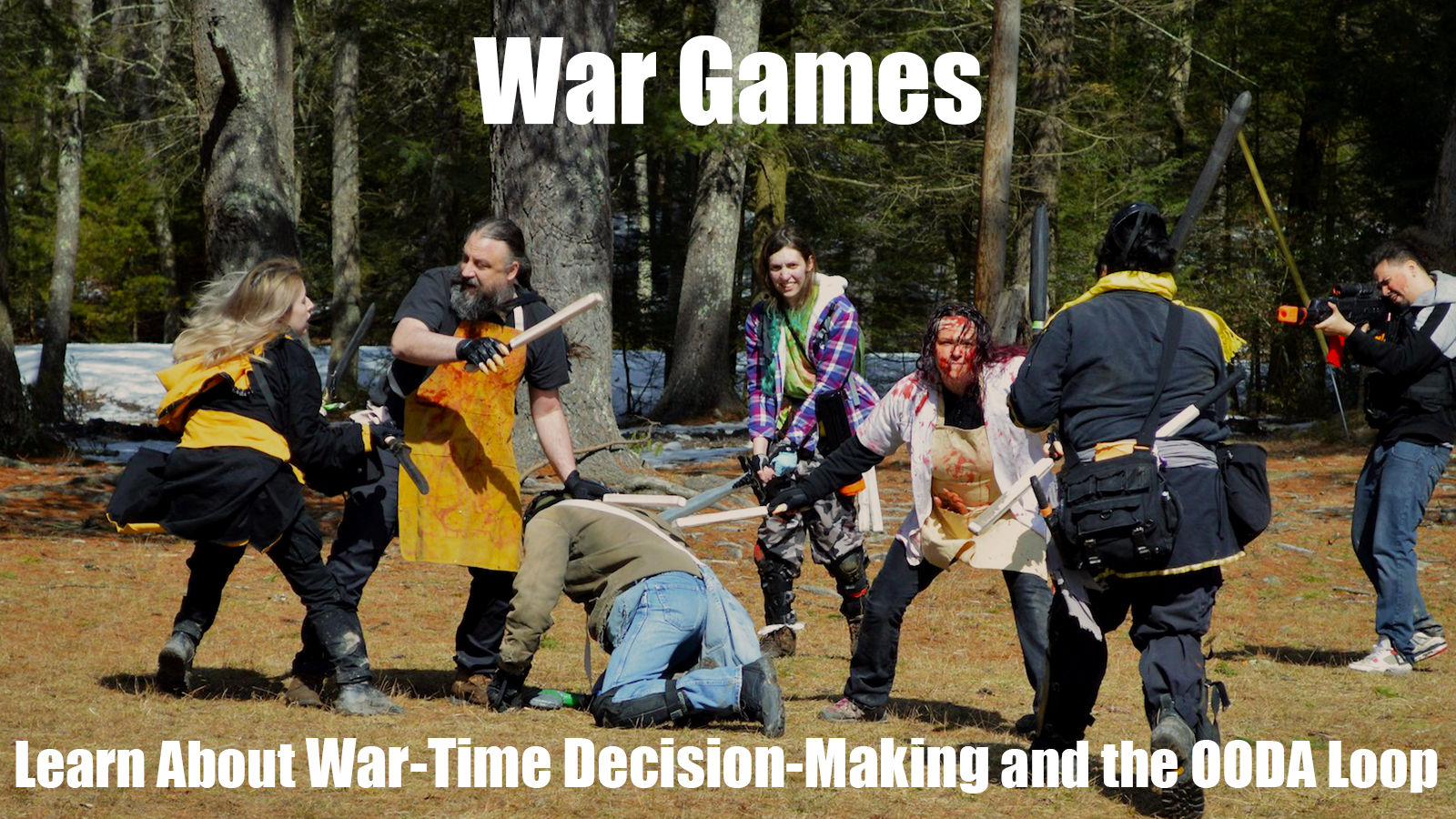
War Games - The OODA Loop
Larp is about making meaningful decisions: your character is presented with a challenge and you have to decide how to act. During a war game like our June Premiere event, Dogs of War, you’ll be given the chance to make choices that will decide the Battle of Requiem.
Larp is about making meaningful decisions: your character is presented with a challenge and you have to decide how to act. During a war game like our June Premiere event, Dogs of War, you’ll be given the chance to make choices that will decide the Battle of Requiem. However, most of us are not experienced military tacticians, and even those who consider themselves adept at strategy games might not know what to expect from a game like Dogs of War. So how are you supposed to make a meaningful decision in a war game?
The Problem: Don’t Take Too Long
Gen. George Patton said, “A good plan, executed violently now, is better than a perfect plan next week.” He was addressing a common problem, not only in warfare, but anytime a person might need to make a choice: decision paralysis. When in a high-stress situation, people usually don’t have all the information they need to make a perfect decision, and the risk of them making a wrong decision leads to them taking too long and not making a decision at all. In modern military forces, this is why we have a professional officer corp: while anyone with military experience knows a 22 year-old Lieutenant is probably ignorant to the point of being dangerous, they still get to give the orders. Why does this work? Because the young officer has been trained (and will continue to be trained by their troops) to be the one who makes a decision in a crisis. Early on, they’re given simple situations to command, and as they progress, they learn to be decisive in more complex ones.
However, this is a larp, and our players don’t typically have years of experience or training in these situations. So what tool can they use to make sure they make quick and effective decisions?
The OODA Loop
The OODA Loop is a relatively modern doctrine that can be used easily in larp to make effective decisions in a crisis situation (like you can expect to encounter during Dogs of War). It was developed in the 1970s by a fighter pilot who used the acronym OODA (Observe - Orient - Decide - Act) as a model for military decision-making. It’s extremely effective in any sort of competition that’s not completely turn-based (and as such, is often applied in competitive situations such as business or politics). The basic idea is that instead of making the most optimal decision in a given situation, you want to make a quick but effective decision and get “inside” your opponent’s loop. As you make decisions and execute them, you change the situation, so your opponent’s “optimal” decision is now based on outdated information.
The OODA Loop consists of four steps, repeated endlessly in a cycle:
Observe - Take in new information. In terms of larp, this might be a piece of intelligence, the appearance of new NPC enemies, or just noticing something new.
Orient - It’s one thing to have new information, it’s another thing to understand it. This step places the new information in the context of everything you already know about the situation.
Decide - Once you have an understanding, make a decision. It doesn’t have to be perfect, but if you’ve oriented yourself properly, you already know the options and risks involved. Don’t dwell on them, make a choice.
Act - Once you make a decision, execute it. Acting upon your choice changes the situation, and generates new information that both you and your opponent will have to address… by observing the new situation, and starting the OODA loop over.
Using the OODA Loop In Larp
Once you stop trying to make the perfect decision, and instead focus on quick, effective decisions, you’ll realize this is a good path toward success. Throughout Dogs of War, we’re going to be offering you the chance to gather intelligence… through spying, research, and role-play. You might want to gather as much information as you can before you make a decision, but that’s how you’ll fall behind: we’ll keep coming at you with new information that will change your understanding, and if you don’t make a decision and act, then you’ll fall behind. Conversely, if you come up with a decent plan right away - and execute it - you’ll probably be successful.
For example, at 0100 on Saturday morning, a research team might decode a message that reads, “The commanders will be meeting at the tent near the latrine tonight” (an observation). However, there are at least six latrines in the play area, all spread out amongst the different campsites. You know you want to capture an enemy commander (an orientation), but how do you do it? As you take 20 minutes to figure out what to do, the research team decodes a second message, “The meeting will occur at the campsite closest to the morgue at 0130.” However, that campsite is nearly a mile from the A-Frame… there’s almost no chance for you to get a team there anymore.
Compare this to a group focused on agile decision-making: once they realized that there were six latrines, they quickly got a dozen people together and started sending people in pairs to each one (a decision). Now, when the team decodes the message, they have a dozen people closer to the objective: a single runner can probably alert them all with time to spare (an action).
So What Does This Mean For Dogs of War
We want you to experience what it means to be making decisions during the stress of a wartime situation. You should be doing a lot, even if it doesn’t seem to do much, because it’s constantly putting you in a better position for when it does pay off. As we get closer to the event, we’ll make sure you have a design document that helps set the context for your decision-making: what the stakes are, what happens if specific things go wrong, and what you can accomplish if you achieve certain objectives. As you get a piece of information, use the OODA Loop to quickly make a decision. Not only will you likely be more successful, but you and those around you will have a fun time winning this war.
The Bunk Problem
There’s a disconnect between the problems that larpers talk about and the problems that they really care about. Some concerns are pretty clear and constant: people want a safe game with supportive players, for example. Other worries are more insidious. One in particular rarely gets talked about… it’s one of the biggest problems our players worry about before the weekend, but rarely gets a second thought afterwards. We’re talking about the bunk problem… and our unique solution to it.
What Is the Bunk Problem
The bunk problem is the problem that until you get to site and drop your stuff on a bunk, you don’t actually know where you’re going to sleep. And our sleeping space is very important (despite the fact that most of us don’t use it nearly enough during the event). We also tend to have a lot of criteria we’re looking for in a bunk. We might want a bottom bunk or a bunk with more support. We might want it in a particular cabin with our friends. We might want it to be safe from undead intruders or have a hiding space to avoid theft. Regardless, most of us have a bunk we really want.
Whenever we get over a hundred people on site, we start hearing people say “there are no bunks left.” This is never actually true… we actually end up disassembling dozens of bunks because we have too many on our site, and we need more indoor space. It’s not that people are lying, what they mean to say is that “I can’t find a bunk that fits my needs.”
The Solution That Isn’t - Med Sleep
Some people have sleeping needs; for these people, we make reasonable accommodations. In the case of bunks, it’s almost always Med Sleep. We typically have the ability to help people out if they come to us with a specific issue (and without disclosing the requests people have made, we get some unexpected ones). But the problem is Med Sleep only meets people’s needs: it doesn’t help fulfill their wants.
Dystopia Rising is an immersive game, and sleeping in character is a big part of it. It’s not just the possible danger of being attacked at night. We want the camaraderie of bunking with our friends. We want to set up our character’s sleeping spaces and maybe even spread out a bit. We want the comfort of a short walk to the showers (or even the convenience of having one in our own room). There’s a reason people want these things in a sleeping space… they’re awesome. But the issue is that everyone wants the same thing, and we only have a limited number of bunks that have it all.
Bunk Anxiety
If there’s stuff everyone wants, and limited amounts to go around, people will start competing for it. Once we hit about 120 people on site, someone is going to have a quarter-mile hike to the showers. We’ve only got eight bunks that have their own shower and bathroom. There are only 12 spots in the cabins. If you want one of those bunks, you have to beat out everyone. And when you’re rushing to get out of work and get to game, you’ll probably develop some anxiety about it.
A lot of these worries come from other sites and older games. There have been plenty of DR games where the last people to show up have slept on the floor - this isn’t going to happen at Forestburg Scout Reservation. Regardless, it’s something that people feel, and unfortunately, it often drives us to break the rules.
The biggest problem that occurs is people saving bunks. We’re constantly seeing people put their stuff on multiple beds. While this behavior is wrong and a violation of both our chapter’s rules and one of the basic social contracts… we understand why people do it. Which is why we incorporated the concept of Bunk Slips into our Early Bird promotions.
Our Solution: Bunk Slips
Every month, we offer perks to folks who sign up early; one of these perks are the bunk slips. Essentially, it’s a way to save a bunk that’s allowed: when your friend shows up at site, they can grab a piece of paper with your name on it, and use it to save a bunk for you. People on Early Set-Up get first dibs, and usually the “Hotel” and the smaller cabins fill up quickly, as well as the bottom bunks in the Anderson-Ambrosia cabin or wherever Lonely Streetz is sleeping.
This is about as fair a way to reserve bunks as we could figure out. Remember, no one is entitled to a particular bunk - you don’t have a bunk that’s “yours.” The best thing we can recommend is to make sure you buy tickets during the Early Bird promotion and then volunteer for Early Set-Up. Not only will you be able to make sure you get your bunk, but then you’ll be able to grab your friends' slips and reserve theirs.
The Early Bird for April ends this week… if you want to make sure you get your bunk slip and choice of NPC slots, sign up today!
What’s Old Is New - Returning Players
At Dystopia Rising New York - and to a degree, the network as a whole - we think a lot about new players… how to recruit them, how to make them have a good experience, and how we can bring them back for more. And this emphasis is important! New players are the lifeblood of any larp, and there’s a good reason we focus on them. But sometimes, in our zeal to improve the experience for new players, other groups get left behind. And one group in particular needs some attention these days: returning players.
What Do We Mean By “Returning Players?”
Given time, everyone moves on from their favorite larp. Maybe our lives change, maybe we leave for health or physical reasons, or maybe we just lose interest. But sometimes, people come back. Their reasons vary: maybe they’ve resolved the situation that kept them from larp, like they finished grad school and now have free time. Or maybe they missed their friends and want to see them again. For whatever reason, a returning player is someone who took an extended break and decides to come back.
Often these players have some common traits:
They probably never played under the current ruleset, and are unfamiliar with how the rules work.
They previously played for a decent period of time, having established themselves and their character in the larp.
They probably don’t recognize a lot of faces, as many of their friends have also moved on.
The Issue: We Don’t Offer Returning Players the Same Level of Care
So imagine if a new player showed up, didn’t know the rules very well, didn’t have many friends, but had a strong character concept they really wanted to play. How would you treat them?
Now imagine someone showed up and does the exact same thing, but they’re a returning player, their strong character concept is actually based on years of play with which you’re unfamiliar. How does that dynamic change for you?
A returning player is a lot like a new player, only they’ve invested time into their character concept, and it’s harder for them to change it. If anything, they have a bigger obstacle to play in some way: they can’t easily recalibrate years of history with a hand wave. Further, the game has changed quite a bit in terms of setting in the last few years, meaning there’s a lot of change to navigate. But a returning player has another obstacle to clear: the resistance of existing players.
Larpers sometimes have a bad tendency to establish a hierarchy, particularly in long-term games. It takes a while to earn experience, establish social connections, and set up things like in-game organizations or businesses. When a new player arrives, there’s no threat of competition: this new player has to take time to establish their character. But a returning player might come back with a significant amount of experience, stacks of in-game money and scrap, and memories of social connections that they find important. They might have been leaders of organizations previously… and if they try to reestablish themselves, other larpers might look at it as a threat.
The result? Where a new player might get assistance, a returning player might get ignored, or worse, a defensive correction. If a new player comes in and starts making up a magnificent backstory on the spot, they’re greeted with enthusiasm, but if a returning player tells a similar story that happened in actual play, other players often fail to engage or worse, shoot them down. Returning players need support too and often they’re met with indifference or worse.
So What Should We Do?
Returning players need our support. After all, they decided to come back for another shot… while it’s hard to try something new, it’s just as hard to come back after years away. Here’s some specific solutions to help returning players engage with the game:
Tell… and listen to… war stories. Nostalgia often plays a part in a player’s decision to return. Don’t just listen when they tell you about something that happened at a game ten years ago; ask them about it. Find a common point and tell a similar story. But engaging with these stories takes “ancient history” and makes it into shared history.
Involve them the way you would a new player. Lots of us are very good at inviting new players to join us in various activities. Extend that same courtesy to returning players. What’s more, work to get them involved, particularly in things like religious activities or criminal influence meetings. They may have been highly involved previously: let them get involved again.
Guide them through change, don’t just correct. A lot of story elements have changed. Some changes were dramatic and often done to remove problematic elements from the setting. Many were more subtle. Sometimes, a returning player might not be “playing the same game;” when this happens, you probably need some extended role-play to guide the player through the changes, as opposed to just telling them they’re wrong. Remember, change is hard, and it’s harder when people aren’t patient.
Let them shine, particularly when they use their skills. The ruleset we use has changed a lot, and it can be extremely frustrating for a player who remembers how their character previously played when they’re struggling with a deadlier system today. If you have a chance to let them be the one who uses their mechanics to save the day, encourage them. Having a few “wins” early on can help them enjoy the system much more.
What About The People Who Never Left?
We’ve talked about how to help returning players, and we try to make every effort to help new players, but there’s another group we should mention: our regulars. While new and returning players have particular obstacles, our regulars are just as important, and deserve to enjoy the game as much as anyone else. If you’re a regular, don’t forget: while it’s important to help new and returning players, your fun is also important. You’re not wrong to advocate for your own experience, as we know you will be mindful of others while you do.
Prepping For the Big Game
It’s finally here… Honor’s Fall is tomorrow! As you get ready to join us for our game of the year, we wanted to offer you some tips for how to prepare for the game. Some of these are very practical, while others are emotional: pre-gaming for moments of frustration or anxiety will help you manage your experience at the event, and help you enjoy it.
1. Anything You Can Do Now, Do It Now
When you wake up tomorrow, you’re going to have a big journey ahead of you. You’re probably going to need to go to camp, drop off your stuff, set up your bunk, and get food for the weekend… and that’s not considering eating, resting and drinking water. If there’s something you can do now, the night before, do it. Your future self will thank you.
2. Everything’s Going To Take Longer When You Get There
We’ll have twice as many people on site as we’ve ever had. It’s going to take you longer to drive on site, twice as long to pick up your character packet… you’ll have to either wait twice as long or walk twice as far to go to the bathroom. Think about those things, and remind yourself that everything will take longer with all the extra people.
3. Check Your Essentials
Here’s a list of things we often see people forget (think PIST, because you’ll be pissed if you forget them): your Pillow, Item Cards, Shoes (this happens more than you think) and Toiletries. Make sure they’re with your kit so that you don’t forget them.
4. Anticipate Your Low Point
We all have parts of the Dystopia Rising experience that upsets us. Maybe you hate being hot and sweaty. Maybe you hate it when the showers run out of hot water. Maybe someone in your crew wakes you up at 9 am every morning. Whatever it is, ask yourself “what pisses me off every game?” Because with 200 people at Honor’s Fall, it will happen. Anticipating it, and realizing “wow, I’m really angry right now,” will help you identify your low point and work through it.
5. Plan Your Meals, Then Add Two Snacks
Normally, we’d advise you to add one snack, but Honor’s Fall is an extra day. It’s important to have a plan for putting calories in your body, and once you make that plan, back yourself up. Make sure it’s something you like to eat… get something easy and prepackaged that you consider comfort food. When there’s no hot food around, being able to grab that snack will make a difference.
6. Get Some Sleep Tonight
Seriously. Playing Dystopia Rising from Friday to Sunday can be exhausting. Not only are we starting Thursday, but we will be running mods all night Saturday. Don’t start the event sleep deprived.
Tips For CvC
Dystopia Rising New York is a Character-versus-Character (CvC) oriented game. Despite this, there’s not much more CvC than you might find at other chapters - even at Honor’s Fall, there have not been many instances where one character attacked and killed another. Instead, our CvC has many levels.
Dystopia Rising New York is a Character-versus-Character (CvC) oriented game. Despite this, there’s not much more CvC than you might find at other chapters - even at Honor’s Fall, there have not been many instances where one character attacked and killed another. Instead, our CvC has many levels: characters yelling at each other over disagreements, direct competition for resources, and indirect jockeying for power. However, we do expect CvC to occur when the sun goes down Saturday night at Honor’s Fall, and wanted to offer a few tricks to help people enjoy the experience.
Don’t Confuse the Possibility of CvC With Actual Conflict
Practically all of Requiem is Wasteland. You can be attacked at any point without a guide. So how come there’s not much CvC violence in Requiem?
The answer is simple: CvC conflict requires both motive and opportunity, and the possibility of CvC only offers players the opportunity to attack other players. The structure and style of Requiem means that there’s not much random violence from player characters (the same can’t be said for some of the roving bands of NPCs you might encounter, of course). The constant opportunity for violence means there’s always the possibility of CvC, but it’s extremely rare for actual conflict to occur without a motive.
So the first CvC tip is this: consider who specifically might want to attack or kill your character… and if you can’t think of anyone, relax a bit. If you can’t think of anyone who might hire an assassin to kill your character, there’s probably no one coming after you. If there is someone, and you really don’t want to engage in CvC, reach out to them and talk. Which brings us to our most important tip.
Engaging In CvC Is a Sign Of Respect and Trust
It’s actually really hard to kill a player in Dystopia Rising, particularly without a guide. In the heat of the moment, calls get missed, Body gets miscounted, and people use rules incorrectly. This isn’t necessarily cheating… people make mistakes. It’s incredibly important to give your other players the benefit of the doubt, to show empathy, and remember that behind that character you’re fighting is another player.
Here’s our next tip: only engage in CvC with players you respect and trust. If you don’t, then you can’t count on them to work through bleed and keep things in character. If someone’s about to engage in CvC with you, take that as a sign of respect and trust, and if you don’t want it, say so… politely and respectfully… out of character.
Remember: it’s easy to mistake a person trying to hurt your character as trying to hurt you (this is the very definition of bleed). If you feel scared or threatened, saying so out of character is a quick way to see an enemy character turn into a helpful, out-of-character friend.
Play Hard, Play Through, and Leave It All On the Field.
Okay, so you’re ready to CvC. You know your target - it’s your buddy, and you two have been hyping up the conflict for months. Your character is going to try to murder theirs, and when the siren goes off on Saturday, it’s go time. So how do you do CvC cleanly and fairly?
First, play hard. This means putting all your effort not only into “winning” (in-character, of course) but making sure you’re following all the rules and playing fairly. Do you have a killer combo that you’re sure works? Run it by the staff to make sure everyone agrees it works like you think it does. Check your cards to make sure they’re not expired. Go over your character’s skills so you know what they cost. It’s not enough to play hard once the siren goes off… if you’re planning any CvC, you have to prepare just as hard so that any conflict goes smoothly.
Second, if there’s a problem, play through. It doesn’t matter if you’ve devised the perfect death trap, and have your enemy Mangled, tied up, and under “No Escape” in Bleed Out, and the guide lets them “Never Here.” That’s a blown call, and it’s wrong, but just keep playing. It’s okay to do a quick clarification of a single sentence (“Can you “Never Here” under “No Escape?”), but after the guide reaffirms the call, don’t argue, and play through. It sucks, but there will always be blown rules calls in even the tightest of games, and you have to keep going.
Finally, leave it all on the field. Maybe you kill your friend’s character. Maybe they kill yours. During CvC, your emotions will be high and that can lead to great role-play. So let it… and let your character scream, cry, and have all the negative emotions you’re experiencing, so that when you go out-of-character, they’re purged from your system.
Remember, larping isn’t real, but it really happens. You’re not actually trying to kill the other player, but you are stalking them silently through the woods, and about to hit them with foam weapons with murderous intent. You’re going to have a lot of feelings when that’s happening! It’s easy to say “well, we’ll keep everything in character” when you’re at home, reading this blog, but you should prepare for the heightened emotional state that comes with CvC. Preparing now, and thinking about how you’re going to manage your emotions will help you immensely when the siren sounds at Honor’s Fall.
Confusing Calls, Made Simple, Part 3
This is part of a series of articles that attempts to make some of the more confusing rules calls simple. In this one, we look at some reminders from our Rules Guides. Don’t forget to check out Part 1 (particularly for Damage Reduction) and Part 2 (about ways to incapacitate someone).
This is part of a series of articles that attempts to make some of the more confusing rules calls simple. In this one, we look at some reminders from our Rules Guides. Don’t forget to check out Part 1 (particularly for damage reduction) and Part 2 (about ways to incapacitate someone).
Reminders
A couple of reminders from our previous parts:
If you call “Bane” on a damage call against a creature with damage reduction, they just cancel out. Pretend it’s a normal damage call… it doesn’t get increased or decreased.
We talked about untying someone’s bonds in a previous blog, but don’t forget: if you want to untie someone quickly (5 seconds), it takes 1 Mind to cut their bonds. Otherwise it takes 1 minute but no Mind.
If you’re Stunned (including Takedown), you have to crumple to the ground for 5 seconds. You can’t just stand there.
Bleed Out
So… you’re reduced to 0 Body. Congrats! You’re in Bleed Out. First, realize that you can’t fake Bleed Out, so if you take a hit, fall over, and start acting like you’re dying, you’re going against the rules. There’s no real reason to lie down in a fight if you’re not in Bleed Out, so don’t do that. Bleed Out ends when your Bleed Out timer expires (typically 5 minutes, but some items or skills can change that) or you receive a Killing Blow. Once it ends, you’re dead and should lie on the ground for 10 minutes before going to Ops.
What’s a Killing Blow? Generally it’s a strike that takes three seconds, that you then declare. While you have to role play it, you don’t have to count out loud (although it’s a good idea if you’re an NPC to count to create a compelling scene). Murder acts as a Killing Blow as part of a strike, so effects that prevent Killing Blows prevent the effects of Murder.
The Lexicon
We have some terms in the Lexicon that you should know; it collects a number of rules into one place. Some highlights:
Agony - This call is countered by Basic Mental Endurance if it’s an Area of Effect or By My Voice call, or by Avoid if it’s delivered via a Strike or Ranged Attack.
Nail - This skill is countered by Avoid unless it’s an Area of Effect or By My Voice call, then you’re just stuck. It just forces you to keep your foot in the same spot on the ground for 1 minute or until you enter Bleed Out - you can still use skills and defend yourself.
Terror - This skill is countered by Basic Mental Endurance, and makes you flee for 30 seconds. It’s different than Fear, which just prevents you from attacking the source of your fear.
On the topic of Fear, please note you can’t use Basic Mental Endurance to counter it, and it is broken when you’re attacked by any foe; it doesn’t have to be the creature that caused it, but it can’t be your buddy tapping you for 2 damage.
Other Notes
Some other notes our Rules Guides asked us to pass on:
You can’t target yourself with a skill unless it says otherwise.
When you use your last Resolve, you can’t use items that cost or make you lose Resolve for the remainder of the event (this means no injectables!)
When you’re Blinded, you can’t use skills you’ve spent build on, so you can’t use Florentine.
If you Break something trapped, or the trap itself, you trigger the trap. Breaking containers Break the contents.
Tips for Travelers
With over 100 travelers expected for Honor’s Fall, it’s possible the locals might actually be outnumbered by visitors. While we’ve designed our modules, such as the Hot Zone and the Bacchanal, to include people with little to no experience with Requiem, traveling to another game, particularly for the first time, brings specific challenges. How do you get involved when people already know each other, and probably already have specific plans? We have two tools to offer travelers, as well as a request for locals to help them out.
“Can I Come With You?”
The first problem a traveler faces is that they’re probably not going to get included in a lot of plans. This isn’t because people don’t like you or don’t want to play with you… it’s just because they’re used to doing things with another group of people, so those are who they think about when they say “hey, let’s plan a Hot Zone run,” or “let’s go to the waterfall.” Sometimes, when you’re sitting alone and watching other people do stuff, it can feel very isolating. When that happens, try this - ask someone who’s heading off to do something, “Can I come with you?”
Consider this blog your official permission to invite yourself to just about everything. There might be in-character consequences: you could get contaminated in the Hot Zone, and there’s probably some fallout if you crash a Murder Inc meeting, but these can be a lot of fun. Out-of-character, everyone at the game wants you to have a good time, so you’re not intruding. Just ask, “Can I come with you?” and we’ll get you involved.
“Will You Help Me With This?”
Another problem travelers face: they make a plan… to sell something, to do something with criminal influence, or organize a faith gathering… and it just doesn’t work that well. In your home game, maybe you’re the big food vendor or the Inner Circle member or high priest of your faith. In Requiem, people probably go to someone else, and it’s hard to take the initiative and lead big events. Instead of getting frustrated when people don’t get involved with your ideas, just ask someone, “Will you help me with this?”
Helping someone is a lot different than buying something from them or committing to their plan of action. Asking for help lets the other person know you’re trying to do something and need assistance. It is a favor… but it’s one people will do for you, because we want you to have a good time. So ask for help, because while people might decline an offer out of lack of interest, they’ll probably answer a request for assistance.
What’s a Local To Do?
If you’re a local, you might have noticed we’re putting the onus on travelers to seek out company and assistance. This is important… people have to put themselves out there to get involved. But asking “Can I come with you?” or “Will you help me with this?” is hard, particularly when they’re asking strangers. So we’re asking locals to just say “yes,” to travelers. Bring them along on your secret meetings and Honor’s Fall murder parties. Stop and help them out if they’re trying to sell food at the Bacchanal or need folks to help harvest crystals in the Hot Zone. When a traveler asks you for something, assume they just want to get involved, say “yes,” and help them out.
Remember: the person most responsible for you having a good time is you. But also remember that everyone wants you to have a good time, and are willing to help out. So travelers, remember your questions and ask people to get you involved, and locals, all you have to remember is to say “yes.”
Big Event Larping
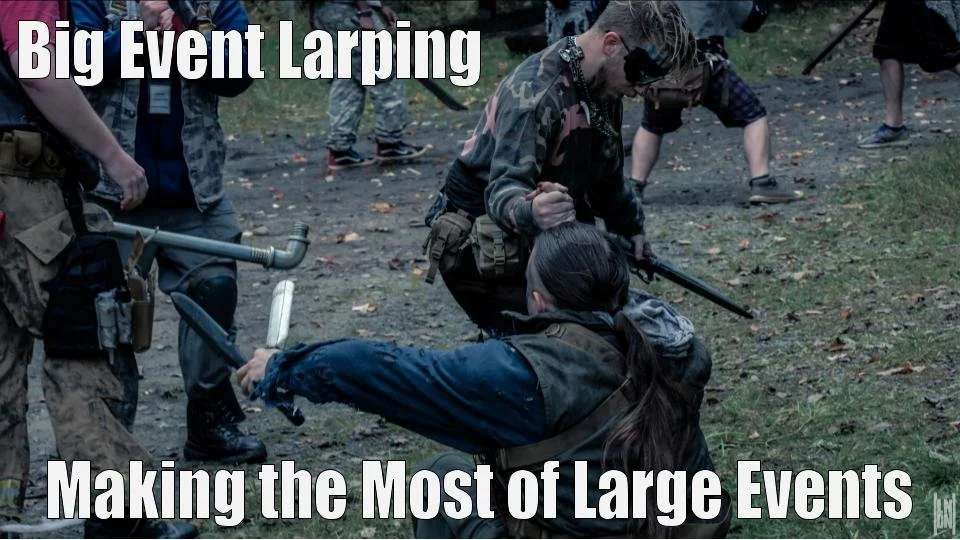
There are games, and then there are games. A Dystopia Rising chapter typically runs between 8 to 12 games a year, and for the most part, they’re relatively uniform: a chapter has a typical level of attendance that remains constant, plots players can expect, and plenty of time for socializing. However, once a year we all get to host a premiere event, and when we do, we want to make it into an event. It is, after all, our game of the year. And so we’ll promote it, offer more build, and do everything we can to attract players. But doing so makes a problem for our players: with great hype comes great expectations. How can a large event live up to expectations?
As many players are new to large events (or worse, have had bad experiences), here’s some things you can do at a premiere event (such as Honor’s Fall) to make sure your big game is one to remember.
Big Means Big
Big games run differently than smaller events. For one, there’s a lot more people, so combats tend to be either very large or over very quickly. If the staff send out a role-play mod, it’s less likely to touch all the players. And anything with a line (like the post office) gets a lot longer. So a lot of the things you might enjoy at your regular game become more difficult to enjoy, simply because of the number of people involved.
It’s important to remember that the staff will design mods and events for many people to enjoy at once, and between these events, there might be less to do. This is especially true for an event like Honor’s Fall, where not only are we running for 150 to 200 people, we’re also focused on running all through Saturday night. To accommodate, we’ve planned a couple of big surprises throughout the event, and also have special events (like the Bacchanal) and special areas (like the Hot Zone) where many people can engage. Take the time to engage with these planned events, so that you can experience firsthand what the premiere event has to offer.
Have a Good Plan, Then Toss It Way
Since there will be more scheduled events, you’ll probably find many demands on your time. Not only do we have two Bacchanals, the chance to enter the Hot Zone, and a full 11 hour horror-spree planned for Saturday night, we’ll still have things like your criminal meeting and other regular events. In addition, with all the travelers, you’ll probably make plans to spend time with people of your faith, friends from out of town, and, of course, the Requiem Families who have a lot to do Saturday night. And this is before we interrupt you with things like the return of our merry band of raiders. There’s a lot to do.
Closer to Honor’s Fall, we’ll release a schedule with everything you need to know about the event. Use it, make plans… then be prepared to scrap them. The important thing is that the act of planning makes you aware of what you can do, and what you want out of the event. Stuff will pop up that will ruin your plans, and you won’t be able to do everything you want to do. Having a good plan, and then being prepared to deviate, will help make sure you hit the events most important to you.
The People Are The Biggest Part
For all the modules we write, props we make, and stories we tell, the most important and engaging part of Dystopia Rising are the other players. As we approach larger numbers on site, more players will be creating content - cooking food, playing music, holding faith gatherings - and that is the content we really want to showcase. The reason we’re holding a Bacchanal is to present some of the best our game has to offer in terms of food, entertainment, and crafting. However, this player-created content isn’t limited to the Bacchanal, and we encourage you to create an event (or distribute pamphlets, or just jam out with your instruments) on your own.
As the size of the game increases, the focus of the staff broadens and diffuses, so it’s important to realize how you fit in, and to lean on your fellow players. While we’re going to hit you with everything we’ve got (and believe us, our NPC shifts have never been this big), we also want to make sure you find time to engage with all the activities you can, and remember that the best part of any event are the other players.
The Dirtiest Word in Dystopia Rising
Before we talk about the dirtiest word in Dystopia Rising, let’s call out one other problematic larp behavior: splitting (also called black-white thinking). Splitting happens when we look at something as “all good” or “all bad” instead of realizing that the thing is actually a mix of both.
Before we talk about the dirtiest word in Dystopia Rising, let’s call out one other problematic larp behavior: splitting (also called black-white thinking). Splitting happens when we look at something as “all good” or “all bad” instead of realizing that the thing is actually a mix of both. There are behaviors that are all bad (hitting someone in the face is bad larp behavior), but most of the things we do at larp can have both positive and negative consequences. It’s important to remember splitting as you read the blog, because we’re about to say a word that some players have called “the worst thing ever.” Here’s the word:
Gatekeeping.
We’re going to talk about Gatekeeping, why it’s bad for Dystopia Rising, but also the problem with it’s status as the dirtiest word in DR.
What Is Gatekeeping?
Strictly speaking, gatekeeping is limiting access to a community, event, or other social organization. In geek circles, it’s often used to describe people refusing access to various fandoms, often informally (“Oh, you didn’t play during 2.0? Then you couldn’t understand why…”). In Dystopia Rising, we can be a little more specific: it’s usually used by players to prevent other players from accessing certain parts of the game. It might be limiting access to a mod, preventing someone from joining an in-character organization, or hoarding the only copy of a popular print. Like many larps, Dystopia Rising used to have a culture of overt gatekeeping that many chapters, including Dystopia Rising New York, have been working to overcome for years. We want players to have access to all the cool parts of our larp.
Why Is Gatekeeping Bad?
First, gatekeeping isn’t inherently bad, but when it’s a positive, we usually don’t use the word “gatekeeping.” For example, a chapter can issue a Refusal of Service to a problematic individual, and that’s a form of gatekeeping. So are things like Master Criminal Influence mods, which help organize requests for specialized plots and make running the game more manageable. However, we’re not talking about these forms of gatekeeping.
“Bad” gatekeeping typically involves players not sharing. Sharing is an interesting virtue; we teach children to share, and then forget how to do it as adults. Gatekeeping typically involves a tendency to say “this is mine” - my plot, my group, my item - when other people want you to share. It’s not gatekeeping to have your own things: to have your own in-character group or have your own equipment. But when someone else asks to join your group, or makes a reasonable request to share a resource, it’s time for a responsible player to start thinking “how do I make sure everyone participates.” Gatekeeping, in the negative sense, is this failure: the failure to share the experience.
We like framing gatekeeping as a failure (as opposed to something with malicious intent) because most gatekeeping is due a lack of understanding. Often, people don’t ask to go on the mod or to see the blueprint or to go to the Criminal meeting. But when someone does ask, and they get a “no,” that is gatekeeping.
The Problem With The Problem
Right now, some readers are bristling, thinking that we’re saying “any time you say ‘no’ to another player, it’s gatekeeping.” We kind of are. But remember what we mentioned at the start of this blog: you have to avoid splitting. Gatekeeping is usually “bad,” but sometimes it has positive or necessary consequences.
If anyone can go to the Criminal Influence meeting, why should people buy the skill? In this case, gatekeeping promotes fairness. If you just bring enough food for you to eat, why should you have to share food and go hungry? In this case, gatekeeping is reasonable. If you don’t pay for in-game goods and services, how can we have an economy? In this case gatekeeping is inherent to the game.
The problem with the problem is entitlement. Sharing implies a communal sense of fairness: we all want people to have a good time. But if we only consider our own access to social resources… can I get in the meeting, can I have some of that food, can I see the super secret new print… we’re not actually concerned about the community. We have to still be fair and reasonable and understand the limitations of the game before we make the call of “gatekeeping.”
People come to Dystopia Rising to play in a world that has scarcity, that has secrets, that has bad people doing bad things, and this means some game elements will always have to be behind gates. Some of these gates require a good deal of time and effort to open these gates, and doing so can be quite rewarding. Remember, you might only see the reward at the end, and not the effort that went into achieving it. Be considerate, even while you advocate for yourself, so that you don’t become part of the problem with the problem.
Search Posts
- CAPs
- Honor's Fall
- PFAs
- Premiere
- appreciation
- crime
- culture
- cvc
- design
- families
- genre
- gravemind
- how to
- immersion
- larp advice
- live
- logistics
- making the most
- narrative
- new players
- npcs
- player tips
- politics
- rectangles
- religion
- requiem
- rules
- safety
- setting
- steering
- storytelling
- survival horror
- travel
- treaty of the fold
- war games