REQ-uired Reading

Important Info Guest User Important Info Guest User

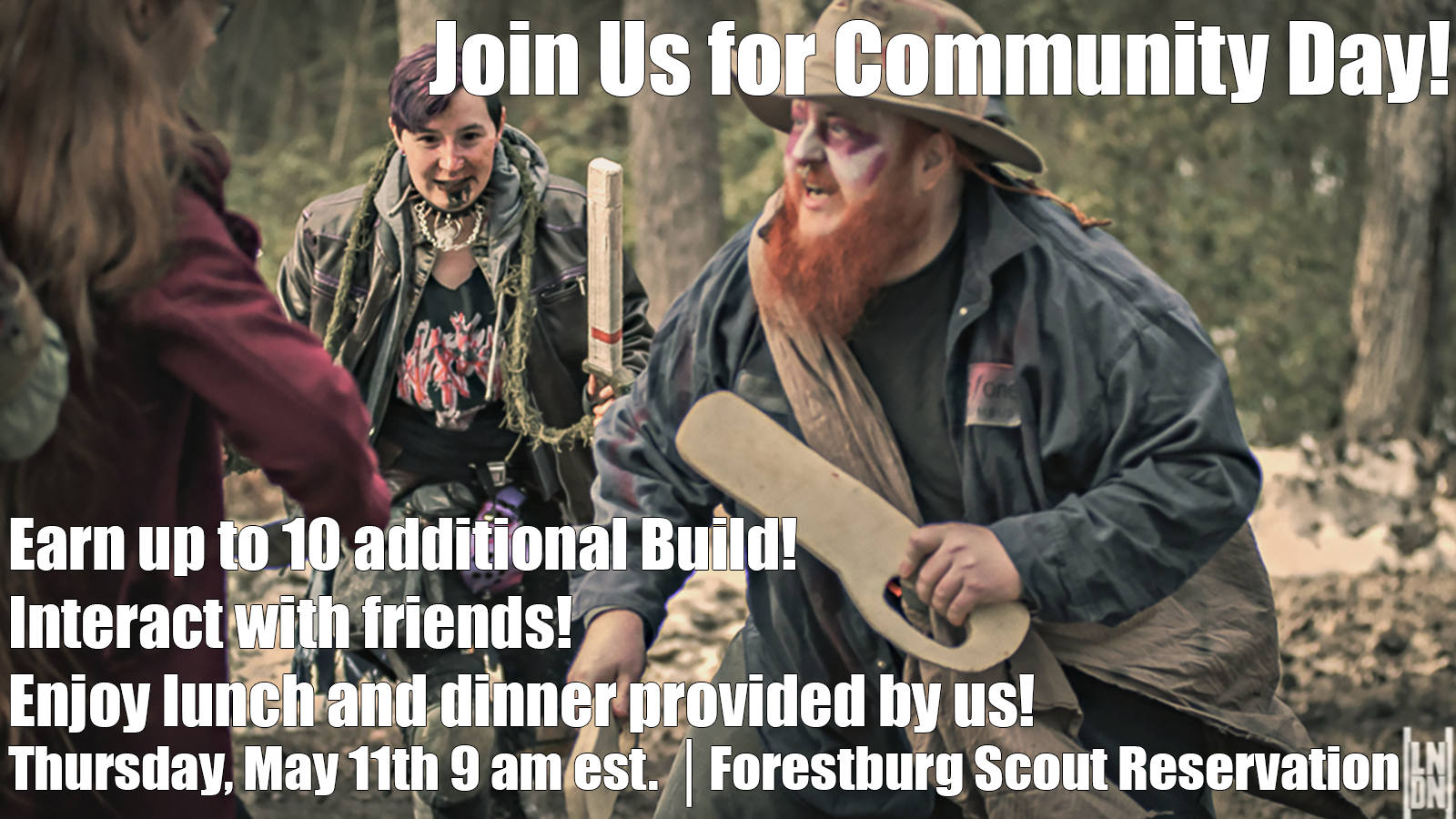
Join us for Community Day

Want to earn 10 additional Build at no cost? Come to Dystopia Rising New York’s Community Day, Thursday May 11th at Forestburg Scout Reservation!
Photo by London Belli

Photo by London Belli

Want to earn 10 additional Build at no cost? Come to Dystopia Rising New York’s Community Day, Thursday May 11th at Forestburg Scout Reservation!

In addition to the extra build, this is an excellent opportunity to give back to the community and interact with friends. 

Fill out the submission form to claim your spot and take part in our Community Day! 

You are not required to attend the full day, all help is appreciated.

What is Expected?

Cleaning and Maintenance are our core goals to give back to our site. This event occurs between 9 am and 7 pm on Thursday, May 11th… you must be able to be on site during this time. Tasks can include but are not limited to:

  • Clean up commonly used areas

  • Assist with upgrading the Med Sleep building

  • Perform trail maintenance

  • Collection and preparation of firewood

What’s the benefit?

DRNY wishes to give back to our site to thank them for allowing us to host our events and giving you a space to be the amazing badasses you are in our world of Requiem. As a bonus, you can expect the following for your hard work:

  • You will gain 1 Build per hour of work, to a maximum of 10 Build per person split between your characters however you want!

    • If you are asked to work over 10 hrs., you will be given Caps for your efforts.

  • A lunch break provided by us!

  • At 7 pm est., we will host a Potluck inspired Community Picnic where you can bring (but are not required to) your own food and instruments to cook and celebrate our community and enjoy a dinner provided by us!

There may also be additional tasks that may need to be completed Friday morning between 9 am and 1 pm Eastern.

Read More
Advice DR NY Advice DR NY

Four Things Players Can Do To Help the Staff

At Dystopia Rising New York, we have an amazing player base who’s always asking us “How can we help out?” Unfortunately, at events we’re often so busy we don’t have a good answer other than “Um, pick that thing up and put it down over there.” So between events, we came up with five things our players can do if they want to help out the staff.
Photo by Allana Marie

At Dystopia Rising New York, we have an amazing player base who’s always asking us “How can we help out?” Unfortunately, at events we’re often so busy we don’t have a good answer other than “Um, pick that thing up and put it down over there.” So between events, we came up with four things our players can do if they want to help out the staff.

Phys Reps

We’ve had this come up multiple times and it’s actually caused a couple of larger issues: you have to phys rep any item not stored in your supply bag. Further, some items need phys reps - typically weapons and armor, and some of these require specific phys reps. In addition, you have to have a phys rep for any injectable or brew you use. If you don’t have a phys rep for an item, it can be “stored” in your supply bag, but you still have to take the item card out to use it. We’ve gotten lax on this, because honestly, it doesn’t ruin the staff’s game if you don’t use a phys rep… but when other players are watching and reacting to what you do… they need to know you did something. 

Mess Up, Fess Up

Whenever we do card checks after a big fight, there’s a tremendous number of characters who happen to have used exactly all their Mind. In a way, this makes sense - you use Mind until you’re out - but we’re also pretty sure some people are losing count and afraid of getting “in trouble.” Please, if you make a mistake, it’s a mistake… you’re not a bad person or a cheater. Let us know, and we’ll make a note and try to help you out (perhaps with coaching, if you want it, on how to keep track of skills during combat). If you tell us “Hey, I messed up” we’re not going to give you a warning, unless it’s particularly egregious (i.e. “Hey, I messed up and accidentally spent 12 Resolve in that fight).

Light Discipline

We emphasize the use of red flashlights and everyone is pretty good about using them… but every now and then we have a problem. Red light doesn’t interfere with night vision, but having a light shined in your eyes still interferes with your ability to focus on anything other than that light. Please, carry a flashlight, use a flashlight, but never shine a flashlight at another person's face. (We don’t know if our guides get flashlights shined at them more often than other people… maybe it’s to see the green headband… but it happens a lot). 

Read This Chart

We have five calls that confuse players more than any others… so we made a chart. Remember, if something is delivered via a strike, you can call Avoid, so the counters on the chart below are in addition to Avoiding a physical strike.

Read More
Important Info DR NY Important Info DR NY

The Bunk Problem

There’s a disconnect between the problems that larpers talk about and the problems that they really care about. Some concerns are pretty clear and constant: people want a safe game with supportive players, for example. Other worries are more insidious. One in particular rarely gets talked about… it’s one of the biggest problems our players worry about before the weekend, but rarely gets a second thought afterwards. We’re talking about the bunk problem… and our unique solution to it.
Photo by London Belli

There’s a disconnect between the problems that larpers talk about and the problems that they really care about. Some concerns are pretty clear and constant: people want a safe game with supportive players, for example. Other worries are more insidious. One in particular rarely gets talked about… it’s one of the biggest problems our players worry about before the weekend, but rarely gets a second thought afterwards. We’re talking about the bunk problem… and our unique solution to it.

What Is the Bunk Problem

The bunk problem is the problem that until you get to site and drop your stuff on a bunk, you don’t actually know where you’re going to sleep. And our sleeping space is very important (despite the fact that most of us don’t use it nearly enough during the event). We also tend to have a lot of criteria we’re looking for in a bunk. We might want a bottom bunk or a bunk with more support. We might want it in a particular cabin with our friends. We might want it to be safe from undead intruders or have a hiding space to avoid theft. Regardless, most of us have a bunk we really want. 

Whenever we get over a hundred people on site, we start hearing people say “there are no bunks left.” This is never actually true… we actually end up disassembling dozens of bunks because we have too many on our site, and we need more indoor space. It’s not that people are lying, what they mean to say is that “I can’t find a bunk that fits my needs.”

The Solution That Isn’t - Med Sleep

Some people have sleeping needs; for these people, we make reasonable accommodations. In the case of bunks, it’s almost always Med Sleep. We typically have the ability to help people out if they come to us with a specific issue (and without disclosing the requests people have made, we get some unexpected ones). But the problem is Med Sleep only meets people’s needs: it doesn’t help fulfill their wants.

Dystopia Rising is an immersive game, and sleeping in character is a big part of it. It’s not just the possible danger of being attacked at night. We want the camaraderie of bunking with our friends. We want to set up our character’s sleeping spaces and maybe even spread out a bit. We want the comfort of a short walk to the showers (or even the convenience of having one in our own room). There’s a reason people want these things in a sleeping space… they’re awesome. But the issue is that everyone wants the same thing, and we only have a limited number of bunks that have it all.

Bunk Anxiety

If there’s stuff everyone wants, and limited amounts to go around, people will start competing for it. Once we hit about 120 people on site, someone is going to have a quarter-mile hike to the showers. We’ve only got eight bunks that have their own shower and bathroom. There are only 12 spots in the cabins. If you want one of those bunks, you have to beat out everyone. And when you’re rushing to get out of work and get to game, you’ll probably develop some anxiety about it.

A lot of these worries come from other sites and older games. There have been plenty of DR games where the last people to show up have slept on the floor - this isn’t going to happen at Forestburg Scout Reservation. Regardless, it’s something that people feel, and unfortunately, it often drives us to break the rules.

The biggest problem that occurs is people saving bunks. We’re constantly seeing people put their stuff on multiple beds. While this behavior is wrong and a violation of both our chapter’s rules and one of the basic social contracts… we understand why people do it. Which is why we incorporated the concept of Bunk Slips into our Early Bird promotions.

Our Solution: Bunk Slips

Every month, we offer perks to folks who sign up early; one of these perks are the bunk slips. Essentially, it’s a way to save a bunk that’s allowed: when your friend shows up at site, they can grab a piece of paper with your name on it, and use it to save a bunk for you. People on Early Set-Up get first dibs, and usually the “Hotel” and the smaller cabins fill up quickly, as well as the bottom bunks in the Anderson-Ambrosia cabin or wherever Lonely Streetz is sleeping.
This is about as fair a way to reserve bunks as we could figure out. Remember, no one is entitled to a particular bunk - you don’t have a bunk that’s “yours.” The best thing we can recommend is to make sure you buy tickets during the Early Bird promotion and then volunteer for Early Set-Up. Not only will you be able to make sure you get your bunk, but then you’ll be able to grab your friends' slips and reserve theirs.

The Early Bird for April ends this week… if you want to make sure you get your bunk slip and choice of NPC slots, sign up today!

Read More
Larp Thoughts DR NY Larp Thoughts DR NY

The Value Of A Regular - An Appreciation Post

The urgency of taking care of new players is typical - and admirable - across Dystopia Rising: people want to make sure newcomers have a good time, and this is a good thing. We’ve also talked about taking care of returning players: people who haven’t played Dystopia Rising for some time, and we’ve talked about travelers too! We’ve talked about just about every group of people who could buy a ticket for our game… except one.
Photo by Shawn Smith

A few members of our staff were in the weekly print meeting recently, which is a meeting where national staff discuss upcoming print releases for the network. During the meeting, people talked about new players, and how we “needed to do something for them.” The urgency of taking care of new players is typical - and admirable - across Dystopia Rising: people want to make sure newcomers have a good time, and this is a good thing. We’ve also talked about taking care of returning players: people who haven’t played Dystopia Rising for some time, and how we’ve taken steps to welcome them back with our returning player drive. And we’ve talked about travelers too! We’ve talked about just about every group of people who could buy a ticket for our game… except one.

And so it’s time to show some appreciation for our regulars.

Your Attendance Is a Gift

There’s a very self-serving reason to give attention to new players: we want them to come back. If we’re doing really well with our new player experience, and we get four new players, only two of them will ever play again, and only one will make it to their sixth game (and these numbers are pretty generous). Returning players have an even worse chance of coming for six games, and most travelers who regularly play at their home game will manage only a couple of games a year. Going all out for these players is a matter of respect and courtesy… but it also helps bring them back, so we have more people to play with. 

Compare that to a player who has come to every game for a year or two. They’re likely to buy a ticket to the next game (they’re probably likely to buy an Early Bird ticket or extra XP). For Dystopia Rising New York, we know that there are about 50 players who make every single game, and another 20 players who attend almost as regularly. This is the core of our game: these are our storytellers and guides, these are the characters best known in the town… these players are essentially part of the setting. And it’s easy to simply expect that they’ll always be there.

But this is a mistake for two reasons: first… that player bought a ticket, same as the new person or traveler or returning player, and they deserve the same amount of attention. We’re not entitled to their attendance, and they deserve the same effort and respect as we give to the players we’re not sure we’ll see again. Their presence isn’t a right, it’s a gift.

Second, regulars always show up… until they don’t. One day, due to neglect, changes in game, or even just life events, they stop coming. If a regular stops playing Dystopia Rising because they move, or change jobs, or even just don’t enjoy larping as much as they used to, that’s okay. But if they move on because the game doesn’t demonstrate how they’re valued, then that’s a failure, and probably a bigger failure than if a new player tries out the game and decides they don’t like it.

Why Are Regulars So Important

Even if we could replace every regular player who quits with two new players, we’d still be losing something, and that’s because our players do so much work to support each other. It’s the regular who picks up someone’s tab at afters or drives them to the grocery store for supplies. It’s the regular who chimes in to give a ride to a game or pick someone up at the train station. The regular makes the food you buy at the game and probably has crafted more than a few of those cool boffers you use. Financially, a regular player gives us more than $500 a year in revenue… and with premiere events and advanced memberships, some give well over $1,000. Regulars are our guides, who do extra shifts and staff shambles. They’re our storytellers, who put in dozens of hours each month to produce this game. They’re the players who have been here two, three, or even five years and never get a mod designed for them. While we’re constantly talking about “players under 100 build” for items, what about the 50% of players who are between 100 and 400?

These players must be engaged, respected  and thanked for their support because this is our core group of players. And like any core group, their support becomes expected, and there’s a tendency to forget to give them positive reinforcement.

Thank You

We wanted to do more than just thank our regulars, so we’ve gone one step further. We’ve given every player who has supported (attended or bought non-attending) at least three games in a row heading into March 30 CAPs to show our appreciation. Further, we’ve gone back and given you another 10 CAPs for every game in your streak for the last year (so if March is your fourth game in a row, you get 40 CAPs, if it’s your fifth, you get 50, and so on… up to a total of 90 CAPs).  We wanted to do this to show that while we really want to take care of our new players, our returning players, and our travelers… we do appreciate that our regulars are the most important people to the success of DRNY.  Thank you.

Remember, we recently introduced new rules for CAPs at DRNY, so be sure to check out the announcement so you can use this token of our appreciation.

Read More
Advice DR NY Advice DR NY

How To Travel

The weather’s getting warmer, and all across the network we have premiere games and national events springing up. This means a lot of us will be traveling over the next few months, visiting other chapters all across the country. Travel can be one of the most rewarding things about Dystopia Rising - you have dozens of games to visit and thousands of friends to see. But it can also be stressful, challenging, and even disappointing. So how do you make sure you have an awesome experience, worth the time you put into it?
Photo by Allana Marie

The weather’s getting warmer, and all across the network we have premiere games and national events springing up. This means a lot of us will be traveling over the next few months, visiting other chapters all across the country. Travel can be one of the most rewarding things about Dystopia Rising - you have dozens of games to visit and thousands of friends to see. But it can also be stressful, challenging, and even disappointing. So how do you make sure you have an awesome experience, worth the time you put into it?

The Challenges of Travel - Change & the Unknown

After a few Dystopia Rising games at your home chapter, you know what to expect. You have a routine. You’ve figured out how to store your gear, load it into your car, and when you have to leave for site. You know who you’re getting a ride with and where you’re sleeping. You know what to do for food and where Afters will be. And when you head to a different chapter, a lot of that goes out the window. Maybe you have to fly and figure out how to get your gear through the TSA. Maybe you have no idea about the bunk situation at the new camp. This means changes to your routine, and further, a lot of unknown variables. And people generally don’t like changes to routine.

So what do you do about these challenges? Here are some suggestions:

  • Be Early. Everything gets easier if you have time. Getting to site early means you don’t have to worry about a bunk, can head to the store to buy groceries, and have time to explore the site. If you can plan to be early when traveling, it’ll give you a lot of options when you encounter an unfamiliar situation.

  • Pack Light. Your character is traveling too… you probably don’t need all your gear. Figure out what you, the player, need to be comfortable and focus on that. The pad you have to sleep on at night? Bring that. The awesome trunk that’s very genre but is a pain in the ass to find space for in a crowded bunk room? Leave it behind. Take what you need to be comfortable, and don’t worry as much about aesthetics and other extras.

  • Be Flexible. Maybe at your home chapter, you and your six friends always grab a cabin and bunk together. You’ve done this every game, and now you’re all traveling to a different chapter… and there’s no space for the six of you to stay together. That’s cool. Split up, meet new people… it’ll be fine. Sometimes, you have out-of-character needs that you have to meet but if it’s an in-character preference, be prepared to let it go.

Don’t forget: if you do have an out-of-character need, contact the staff before you arrive. Let them know if you need med sleep or have specific needs: that gives them time to accommodate (remember, “be early.”)

Being Part of the Game

The biggest challenge of travel might not be the obstacles to getting on site and finding a bunk, but your own expectations. A travel game is special… you might only have a couple a year… and you arrive hoping to have an extraordinary game. And when you get there, you don’t know the local plots, you don’t know the local setting, and all the local players are busy doing their own thing. Sometimes, it feels like you’re a supporting character in someone else’s story.

The trick to countering that is to get involved. Just like you might advise a new player to “try everything,” you have to actively seek out plots and stories. Here’s a good travel challenge: say “yes” to everything. Say yes to every NPC who asks you to help them, say yes to every local who wants to show something, and keep saying yes until you find your niche in this new game. Remember: you are the one responsible for your own good time, and so it’s important that you take charge of your own experience at travel games.

Remember, the difficulties getting involved aren't always a bad thing, particularly if there are other players from your local game there. Often, at our own games, players have a lot to do: multiple meetings, businesses to run, and all sorts of responsibilities to regular players. At a travel game, you might have more time to relax, and might even find yourself spending more time with people you see regularly than you would at your local game.

Helping Travelers

While the onus is on travelers to take care of themselves, they are guests in your chapter… and valued guests at that. They didn’t come here to hear negative things about their home, or how awesome you are. They didn’t travel all this way to sit on a bench and miss out on the plot. They came because they heard your game was a lot of fun and wanted to try it, and probably need your help. It’s important to identify travelers and get to know them: pull them into your role-play and schemes and give them things to do. A good way to do this is to find a feature unique to your game and share it. For example, no one who visits Requiem is disappointed with a trip to the waterfall, so you can invite travelers out to see it. Making the effort to share the game with them could be what makes the trip worthwhile for them.

Travel is what separates a networked game from a bunch of individual local games: we gain something by having a wider world out there, and travel is how we realize that value. The better prepared you are when you travel, and the better you treat travelers, the better all games will be across the network.

Read More
Larp Thoughts DR NY Larp Thoughts DR NY

This Is Your Game - Building The Culture You Want

At Dystopia Rising, we often talk about our Community, and we’re proud of the group of people who create and attend our events at Dystopia Rising New York. But a community is more than a group of people with a common pastime: together, we create a culture, a collection of norms and behaviors that drives our events and allows us to come together to play safely and effectively.
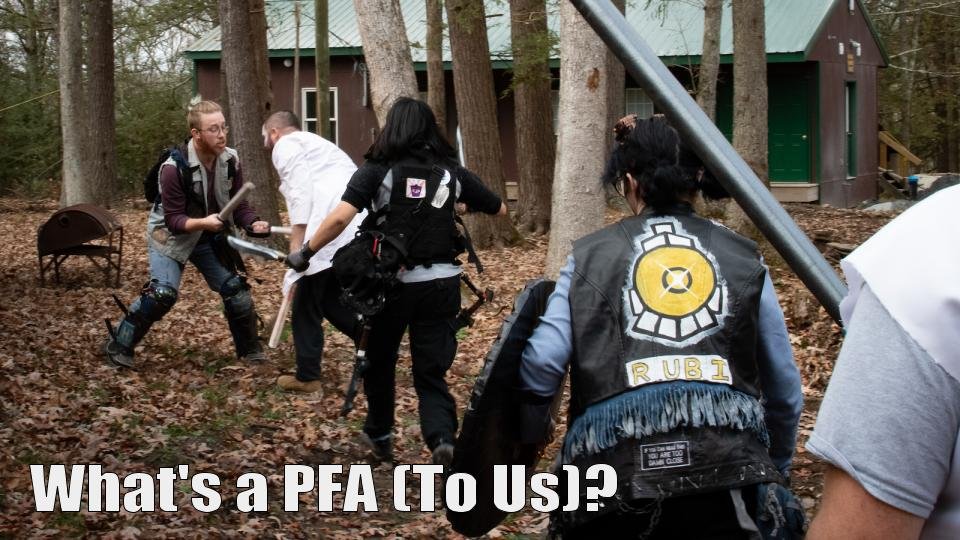
Photo by Shawn Smith

At Dystopia Rising, we often talk about our Community, and we’re proud of the group of people who create and attend our events at Dystopia Rising New York. But a community is more than a group of people with a common pastime: together, we create a culture, a collection of norms and behaviors that drives our events and allows us to come together to play safely and effectively. As we enter the home stretch of our second year of live games, we want to talk about the culture we - both staff and players - are creating together, and how we can continue to excel in 2023 and beyond.

You Are Dystopia Rising New York

Nine times a year, we schedule an event where a couple of directors and a handful of storytellers build a plan, a few dozen guides provide the structure, and a hundred players create a game. We’ve achieved tremendous growth since we reopened eighteen months ago, and that’s not just because of our storytelling, or marketing, or logistics. It’s because of the enthusiasm and effort that the players bring month after month, co-creating with us, and lending their support during set-up, throughout the event, and clean-up. We want to thank you for this - we get a lot of credit for Dystopia Rising New York’s success, and we want to share it with you. Specifically, we want to thank you for what you do, and point out the specific things that make our culture a success.

A Culture of Safety

First and foremost, we, as a community, have to provide each other with a safe and accessible space to play. You’ve been a key part of this in two very important ways. First, you’ve consistently brought your concerns to us in an open and honest way. Our staff between events is relatively small and we can’t see everything. Your emails and conversations serve as our eyes and ears, and let us address everything from inappropriate comments towards other players to logistical concerns at the site. Your inputs have helped us successfully introduce initiatives such as topfree equality, made our site more accessible, and allowed us to manage the risk for events such as The Feast of Flesh. Second, when we respond to your concerns by offering tools to mitigate risk, you use them. We can’t thank you enough for your preparedness during the cold winter and spring of 2022, particularly when we had unique challenges on site. Again and again, when we communicate our problems and our solutions, you work with us as a team to make sure our events are a success.


As we go forward in 2023, we want to formalize this process. As our culture matures and we iron out large problems, we increasingly see individual issues arise that require our attention. When you have a problem, we want to work with you to create a reasonable accommodation that is specific to your needs. This is a flexible and interactive process, and relies on you continuing to bring us your concerns. Remember, when you come to us with an issue, we’re going to assess whether this is a general or specific issue, and likely work with you to establish a solution that allows you to play safely and effectively. Please understand we can’t always implement the specific solutions you ask for; this is a back-and-forth where we work together, and we have to consider the larger picture with all of our solutions. 

A Culture of Accountability

Over the course of 2022, our staff worked very hard to make sure that when we had to make a correction to behavior, we did so to improve everyone’s play in the future, and not to punish past actions. And for having nearly a thousand players, we had very few problems. It’s not that you avoided bad behavior… you actively supported the games. You showed up for early set-up, stayed late to help with other clean-ups, and gave us your all on NPC shifts. Most importantly, you took care of each other, and we knew that if we weren’t there when something happened, our players would step up until we got there.

We can always improve, and as the game grows, we also know we’ll have more instances where people need reminders to do the right thing. These are not call-outs, they’re call-ins; we know people come to our games with the intention of being a positive addition to our community, but sometimes get tired, or distracted, or have problems. Part of our initiative for 2023 is empowering our guides to talk to people on the spot if they’re late for a shift or not engaging in clean-up: we know it’s not because you don’t care, but that we just need to refocus. We’re also going to address underlying issues rather than just telling you to do more: if you’re tired on an NPC shift, expect us to ask you to go to bed and come back, or if we’re worried about an injury, we might ask you to non-com for an event. We understand that sometimes people push themselves too hard, and we’re accountable for your well-being at an event. Accountability isn’t just making sure people do what they’re supposed to, it’s also about taking care of each other.

A Culture of Play

We’re extremely proud of the culture of play at Dystopia Rising New York. You all have handled challenging mechanics such as Compulsion and Unstoppable, long-term plotlines that have taken months to pan out, and altered your playstyle in some cases to buy into the storyteller’s vision. As we prepare for our premiere event in June and Honor’s Fall in August, we’re confident you’ll have a good time, as we all have cultivated a culture of play where we support each other’s choices and come together as a group.

In 2023, you’re going to see more discussions where we talk about how to engage with our plots and mechanics, so you can understand our intent, and engage with them on those terms. We’ve found that if we just roll out a mechanic, you might not understand our vision for how it plays out. Likewise, we often get action requests or emails from players describing what their character does, without telling us the experience they want to pursue. Our goal is more open and direct communication, so that we can continue to build on our current culture of play.

No game is perfect, and we, as a community, have dealt with many problems over the last eighteen months. However, we have, as a community, built a culture where we address problems and continue to communicate about potential solutions. With many of our policies and mechanics now set, we want to work with you to fine-tune our culture, and eagerly await the opportunities to do so in the coming months.

Read More
Rules Deep Dive DR NY Rules Deep Dive DR NY

What’s A PFA (To Us)

Shadow. Bad-Ass. Graverobber. The one thing we’re sure about: Professional Focus Achievements (PFAs) have awesome names. The majority of plot requests we receive at Dystopia Rising New York involve PFAs, as well as quite a few complaints. PFAs are some of the coolest things that can end up on your character’s sheet, and take the longest to achieve… you have to have spent at least 100 Build before you can have one, then put in a plot request. And then… to use one, you have to have an expensive piece of equipment or “be in the right place at the right time.” All this results in PFAs being a source of confusion for players and staff alike. So what is a PFA in DRNY?
Photo by Shawn Smith

Shadow. Bad-Ass. Graverobber. The one thing we’re sure about: Professional Focus Achievements (PFAs) have awesome names. The majority of plot requests we receive at Dystopia Rising New York involve PFAs, as well as quite a few complaints. PFAs are some of the coolest things that can end up on your character’s sheet, and take the longest to achieve… you have to have spent at least 100 Build before you can have one, then put in a plot request. And then… to use one, you have to have an expensive piece of equipment or “be in the right place at the right time.” All this results in PFAs being a source of confusion for players and staff alike. So what is a PFA in DRNY?

A Disclaimer - No One Right Way

First, we’re just talking about PFAs in our local chapter. You might not like our approach, but we want to be clear and transparent about how we treat PFAs. Most importantly - we’re not saying “you’re wrong” if you disagree with us… there’s no one right way to use PFAs. We know that players are (rightfully) very attached to some of the PFA titles (more on that below) and want them to behave a certain way. What’s important is that we’re clear on how they behave at our game.

The Problem

PFAs are a relatively new game concept; we’ve only been playing with them for about three years. The rulebook doesn’t actually tell you what they are… pages 138 through 139 tell you how to get them, but not really what they are. The book does describe the titles associated with Professional Achievements, however:

Titles of Professional Focus Achievements are used as an honorific title related to a skill tree and the skill requirements of related equipment bonuses. They are not intended to be a literal description of any profession, title, or description can ever encompass all potential routes and mechanical design focuses an individual could use to describe a Professional Focus Achievement.

However, at the same time PFAs arrived, an older mechanic - Advanced Professions - disappeared. Advanced Professions were a mechanic you could purchase for your character that opened up unique skills: if you had an Advanced Profession, you could do things no one else could do, like perform Grave Mind procedures, raise the dead, and kill powerful undead by pointing a finger. To receive an Advanced Profession, you needed months of roleplay, with a minimum of three lessons. For most of their existence, these lessons could only be taught by NPCs, and for a time, advanced professions were extremely rare. For many, achieving an advanced profession like Grave Robber, Saint or Mercenary were long-term character goals. They’re very different from PFAs, which are really just capstones to individual skills.

But while PFAs and Advanced professions are different, they have one thing in common: the titles. Many of the old Advanced Profession titles (like the aforementioned Grave Robber, Saint, and Mercenary titles) became PFA titles. So while people remember how important those titles used to be using the old mechanics, they don’t carry the same weight under our current rules system. 

Further Complications

Let’s admit a problem: Advanced Professions went away because they relied on a gatekeeping mechanic. If you met the prerequisites, you could apply for an Advanced Profession and the staff would decide if your character was worthy of it or not. While this did keep Advanced Professions rare and prestigious, it also led to bad feelings if someone was not approved. Further, there were issues of favoritism and, even worse, biases as certain professions were gatekept unfairly. When PFAs arrived, they removed the approval process: while you still have to put in the plot request, you can’t really “fail” a PFA “test.” You just have to meet the prerequisites, put in the request, and after your mod, you put it on your sheet. This effectively solves the gatekeeping problem.
However, without rarity, PFAs lack the same prestige. You don’t “earn” a PFA; you buy it like you would Mind, Body or another skill. You receive a mod not to determine if your character is “worthy” of a PFA, you go through a story to make it more enjoyable. But what about the people who remember being gatekept out of their Advanced Profession, or never had a chance to achieve that goal, and remember what it meant to have one of those Advanced Profession titles? This introduces a new problem: the PFA title doesn’t match player expectations of what that title means.

So What Does A PFA Mean (and Do)?

The best way to approach a PFA in DRNY is to treat it exactly as it behaves mechanically: it means your character has achieved a certain level of skill and knows how to use specific pieces of equipment more efficiently. It doesn’t mean you’re inherently better at anything than other characters without the PFA.

For example, the Shadow PFA allows players to use certain Stealth related items more effectively: with the right items, they can stay in disguise longer and use “Never Here” more advantageously. It also signifies they’ve achieved a certain level of skill at Stealth, and suggests this may be a focus for their character. However, it doesn’t make them “more stealthy” than other characters, or mean they should automatically succeed at Stealth mods. 

But what about the ability to use PFAs in specific plots? Storytellers can design scenarios to include a special opportunity for specific PFAs to stand out with unique mechanics. While we do try to do this in DRNY, the numbers make this impossible - we have about 150 active players in the database, and well over 200 PFAs to account for. Further, this number is heavily skewed: at our last game, we have more than a dozen Shadows (23), Veterans (20), Mercenaries (20), Graverobbers (16), Assassins (16), Flankers (15), Bone Breakers (14) and Inner Circle (13). Even if we include special mechanics for PFAs in our mods, with these numbers, the mechanic has to be something multiple people can enjoy, as opposed an overwhelming advantage one person can use to “win” the mod. 

Big Picture: The Game Has Changed

It’s been three years since we introduced PFAs… the majority of our players never had an Advanced Profession, and at least 20% of them never played with those mechanics. However, when the rules changed, we didn’t emphasize the change enough, and some perceptions bleed over into how we think about PFAs. In human factors engineering, there’s a concept of negative transfer - where you take previous expertise in a situation, and apply it to a new situation where your expertise doesn’t quite fit. We have to remember not to apply negative transfer to our mechanics… a PFA is a cool title you can add to your sheet, and while it can be very important to you as a player, it doesn’t fundamentally change how your character interacts with the game as a whole. 

Read More
Advice DR NY Advice DR NY

What’s Old Is New - Returning Players

At Dystopia Rising New York - and to a degree, the network as a whole - we think a lot about new players… how to recruit them, how to make them have a good experience, and how we can bring them back for more. And this emphasis is important! New players are the lifeblood of any larp, and there’s a good reason we focus on them. But sometimes, in our zeal to improve the experience for new players, other groups get left behind. And one group in particular needs some attention these days: returning players.
Photo By Shawn Smith

At Dystopia Rising New York - and to a degree, the network as a whole - we think a lot about new players… how to recruit them, how to make them have a good experience, and how we can bring them back for more. And this emphasis is important! New players are the lifeblood of any larp, and there’s a good reason we focus on them. But sometimes, in our zeal to improve the experience for new players, other groups get left behind. And one group in particular needs some attention these days: returning players.

What Do We Mean By “Returning Players?”

Given time, everyone moves on from their favorite larp. Maybe our lives change, maybe we leave for health or physical reasons, or maybe we just lose interest. But sometimes, people come back. Their reasons vary: maybe they’ve resolved the situation that kept them from larp, like they finished grad school and now have free time. Or maybe they missed their friends and want to see them again. For whatever reason, a returning player is someone who took an extended break and decides to come back. 

Often these players have some common traits:

  • They probably never played under the current ruleset, and are unfamiliar with how the rules work.

  • They previously played for a decent period of time, having established themselves and their character in the larp.

  • They probably don’t recognize a lot of faces, as many of their friends have also moved on. 

The Issue: We Don’t Offer Returning Players the Same Level of Care

So imagine if a new player showed up, didn’t know the rules very well, didn’t have many friends, but had a strong character concept they really wanted to play. How would you treat them?

Now imagine someone showed up and does the exact same thing, but they’re a returning player, their strong character concept is actually based on years of play with which you’re unfamiliar. How does that dynamic change for you?

A returning player is a lot like a new player, only they’ve invested time into their character concept, and it’s harder for them to change it. If anything, they have a bigger obstacle to play in some way: they can’t easily recalibrate years of history with a hand wave. Further, the game has changed quite a bit in terms of setting in the last few years, meaning there’s a lot of change to navigate. But a returning player has another obstacle to clear: the resistance of existing players.

Larpers sometimes have a bad tendency to establish a hierarchy, particularly in long-term games. It takes a while to earn experience, establish social connections, and set up things like in-game organizations or businesses. When a new player arrives, there’s no threat of competition: this new player has to take time to establish their character. But a returning player might come back with a significant amount of experience, stacks of in-game money and scrap, and memories of social connections that they find important. They might have been leaders of organizations previously… and if they try to reestablish themselves, other larpers might look at it as a threat. 

The result? Where a new player might get assistance, a returning player might get ignored, or worse, a defensive correction. If a new player comes in and starts making up a magnificent backstory on the spot, they’re greeted with enthusiasm, but if a returning player tells a similar story that happened in actual play, other players often fail to engage or worse, shoot them down. Returning players need support too and often they’re met with indifference or worse.

So What Should We Do?

Returning players need our support. After all, they decided to come back for another shot… while it’s hard to try something new, it’s just as hard to come back after years away. Here’s some specific solutions to help returning players engage with the game:

  • Tell… and listen to… war stories. Nostalgia often plays a part in a player’s decision to return. Don’t just listen when they tell you about something that happened at a game ten years ago; ask them about it. Find a common point and tell a similar story. But engaging with these stories takes “ancient history” and makes it into shared history.

  • Involve them the way you would a new player. Lots of us are very good at inviting new players to join us in various activities. Extend that same courtesy to returning players. What’s more, work to get them involved, particularly in things like religious activities or criminal influence meetings. They may have been highly involved previously: let them get involved again. 

  • Guide them through change, don’t just correct. A lot of story elements have changed. Some changes were dramatic and often done to remove problematic elements from the setting. Many were more subtle. Sometimes, a returning player might not be “playing the same game;” when this happens, you probably need some extended role-play to guide the player through the changes, as opposed to just telling them they’re wrong. Remember, change is hard, and it’s harder when people aren’t patient.

  • Let them shine, particularly when they use their skills. The ruleset we use has changed a lot, and it can be extremely frustrating for a player who remembers how their character previously played when they’re struggling with a deadlier system today. If you have a chance to let them be the one who uses their mechanics to save the day, encourage them. Having a few “wins” early on can help them enjoy the system much more.

What About The People Who Never Left?

We’ve talked about how to help returning players, and we try to make every effort to help new players, but there’s another group we should mention: our regulars. While new and returning players have particular obstacles, our regulars are just as important, and deserve to enjoy the game as much as anyone else. If you’re a regular, don’t forget: while it’s important to help new and returning players, your fun is also important. You’re not wrong to advocate for your own experience, as we know you will be mindful of others while you do.

Read More
Larp Thoughts DR NY Larp Thoughts DR NY

What Is Dystopia Rising All About?

A larp isn’t really an experience - it’s a chance to create your own experience with your friends. At Dystopia Rising New York, we offer many things to enhance that experience - antagonists, narratives and a beautiful campsite - and we have a lot of elements unique to Requiem. But what’s the core of the Dystopia Rising experience? When you and your friends get together and play Dystopia Rising, what do you expect? What about the game appeals to you?
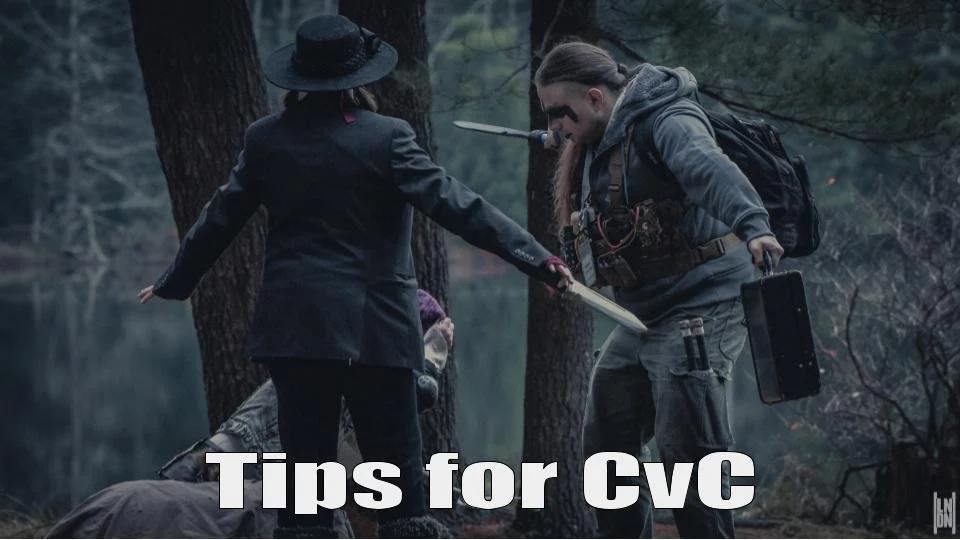
Photo by Shawn Smith

A larp isn’t really an experience - it’s a chance to create your own experience with your friends. At Dystopia Rising New York, we offer many things to enhance that experience - antagonists, narratives and a beautiful campsite - and we have a lot of elements unique to Requiem. But what’s the core of the Dystopia Rising experience? When you and your friends get together and play Dystopia Rising, what do you expect? What about the game appeals to you?

We’ve come up with a few ideas… please let us know your thoughts.

Fighting Zombies (and Raiders and Critters…)

Dystopia Rising is a boffer larp, which means players expect there to be something to fight. It’s probably not the most common activity (if you have 6 to 8 hours of solid combat over a weekend, it’s probably a lot), but it defines the experience. You can hit your friends with foam swords at any boffer larp, but at Dystopia Rising, you get to fight zombies. It’s what makes the larp unique.

It’s also what makes it immersive, because the activity of boffer fighting aligns your body with what your character is doing. We may not be expert sword fighters or marksmen, but the act of swinging a foam sword in real-time in the chaos of a boffer battle feels more real than if we were playing a table-top game with dice. We think this is a major part of the appeal.

Hanging Out With Your Friends In The Woods In Costume

A big appeal of any larp is seeing your friends - larp is a social activity. Sometimes, we get too into it, and it’s our only social activity, but it’s a great way to reliably see a core group of friends every month. And when we do, we play… just like if we were in a bowling league or on a softball team, we play a game. This recharges us, because playing with friends (in this case role-playing) is a vital activity for adults to do.

With Dystopia Rising, we play in a particular aesthetic… and this aesthetic is important. We don’t just play for a couple of hours; we travel to the woods, put on post-apocalyptic costumes, and play for days. We don’t just role-play the exciting parts; we also cook in-character, we play music in-character, we craft in-character. Again, this is immersion, and it’s part of the unique appeal of a Dystopia Rising larp. 

The Weird Stuff

We don’t mean “weird” in a bad way… we mean the stuff particular to Dystopia Rising larps that no one else offers. This could be Gravemind lore. It might be religious roleplay. The economy of the larp is unique and a tremendous draw for some people. There are lots of things that make Dystopia Rising unique, and each one is special to some player.

The important thing with the “weird stuff” is that there’s something for everyone, but not everyone likes the same thing. Some players will jump into a Gravemind scene every chance they get. Others spend hours collecting every blueprint. Having opportunities for both draws players to the game, where they’ll have the chance to hang out with their friends and fight zombies. 

These are just our answers to “what is the appeal of Dystopia Rising?” What parts of Dystopia Rising do you come to game for?

Read More
Advice DR NY Advice DR NY

Tips For CvC

Dystopia Rising New York is a Character-versus-Character (CvC) oriented game. Despite this, there’s not much more CvC than you might find at other chapters - even at Honor’s Fall, there have not been many instances where one character attacked and killed another. Instead, our CvC has many levels.

Photo by London Bellie

Dystopia Rising New York is a Character-versus-Character (CvC) oriented game. Despite this, there’s not much more CvC than you might find at other chapters - even at Honor’s Fall, there have not been many instances where one character attacked and killed another. Instead, our CvC has many levels: characters yelling at each other over disagreements, direct competition for resources, and indirect jockeying for power. However, we do expect CvC to occur when the sun goes down Saturday night at Honor’s Fall, and wanted to offer a few tricks to help people enjoy the experience.

Don’t Confuse the Possibility of CvC With Actual Conflict

Practically all of Requiem is Wasteland. You can be attacked at any point without a guide. So how come there’s not much CvC violence in Requiem?

The answer is simple: CvC conflict requires both motive and opportunity, and the possibility of CvC only offers players the opportunity to attack other players. The structure and style of Requiem means that there’s not much random violence from player characters (the same can’t be said for some of the roving bands of NPCs you might encounter, of course). The constant opportunity for violence means there’s always the possibility of CvC, but it’s extremely rare for actual conflict to occur without a motive. 

So the first CvC tip is this: consider who specifically might want to attack or kill your character… and if you can’t think of anyone, relax a bit. If you can’t think of anyone who might hire an assassin to kill your character, there’s probably no one coming after you. If there is someone, and you really don’t want to engage in CvC, reach out to them and talk. Which brings us to our most important tip.

Engaging In CvC Is a Sign Of Respect and Trust

It’s actually really hard to kill a player in Dystopia Rising, particularly without a guide. In the heat of the moment, calls get missed, Body gets miscounted, and people use rules incorrectly. This isn’t necessarily cheating… people make mistakes. It’s incredibly important to give your other players the benefit of the doubt, to show empathy, and remember that behind that character you’re fighting is another player. 

Here’s our next tip: only engage in CvC with players you respect and trust. If you don’t, then you can’t count on them to work through bleed and keep things in character. If someone’s about to engage in CvC with you, take that as a sign of respect and trust, and if you don’t want it, say so… politely and respectfully… out of character. 

Remember: it’s easy to mistake a person trying to hurt your character as trying to hurt you (this is the very definition of bleed). If you feel scared or threatened, saying so out of character is a quick way to see an enemy character turn into a helpful, out-of-character friend.

Play Hard, Play Through, and Leave It All On the Field.

Okay, so you’re ready to CvC. You know your target - it’s your buddy, and you two have been hyping up the conflict for months. Your character is going to try to murder theirs, and when the siren goes off on Saturday, it’s go time. So how do you do CvC cleanly and fairly?

First, play hard. This means putting all your effort not only into “winning” (in-character, of course) but making sure you’re following all the rules and playing fairly. Do you have a killer combo that you’re sure works? Run it by the staff to make sure everyone agrees it works like you think it does. Check your cards to make sure they’re not expired. Go over your character’s skills so you know what they cost. It’s not enough to play hard once the siren goes off… if you’re planning any CvC, you have to prepare just as hard so that any conflict goes smoothly.

Second, if there’s a problem, play through. It doesn’t matter if you’ve devised the perfect death trap, and have your enemy Mangled, tied up, and under “No Escape” in Bleed Out, and the guide lets them “Never Here.” That’s a blown call, and it’s wrong, but just keep playing. It’s okay to do a quick clarification of a single sentence (“Can you “Never Here” under “No Escape?”), but after the guide reaffirms the call, don’t argue, and play through. It sucks, but there will always be blown rules calls in even the tightest of games, and you have to keep going.

Finally, leave it all on the field. Maybe you kill your friend’s character. Maybe they kill yours. During CvC, your emotions will be high and that can lead to great role-play. So let it… and let your character scream, cry, and have all the negative emotions you’re experiencing, so that when you go out-of-character, they’re purged from your system.
Remember, larping isn’t real, but it really happens. You’re not actually trying to kill the other player, but you are stalking them silently through the woods, and about to hit them with foam weapons with murderous intent. You’re going to have a lot of feelings when that’s happening! It’s easy to say “well, we’ll keep everything in character” when you’re at home, reading this blog, but you should prepare for the heightened emotional state that comes with CvC. Preparing now, and thinking about how you’re going to manage your emotions will help you immensely when the siren sounds at Honor’s Fall.

Read More

Search Posts